Oliver Cromwell is generally accepted as the man responsible for initiating education for his troops and setting up “schools”. Cromwell believed that soldiers who could read and write were more able to follow written orders and of course, there was the moral and philosophical aims within Cromwell’s idea for education. Gradually, children were included in Army schools, preparing boys for a life of soldiering and girls for home makers. Since then, there have been "schools" for the Army and Navy across the world wherever a garrison was established that housed families as well as men. Initially the teachers were soldiers, but by the late nineteenth century civilians were employed as teachers – schoolmasters and school mistresses. With the advent of aircraft and the RAF, schools within the airfields and barracks provided education for the children of service men. So, the three services had established schools across the world, wherever they were stationed. Change began in 1946 with the set up of BFES.
British Forces Education Service (BFES) was formed in 1946, in the aftermath of World War 2 and the establishment of the British Occupied Zone in North-Western Germany and Berlin. BFES' first director, John Trevelyan, was charged with developing a schools organisation so that children acccompanying their parents 'would receive an education at least equal to the education they would have received had they remained in the UK.'
What is not well known is that schools for the children of service families existed outside of UK and before the Second World War.
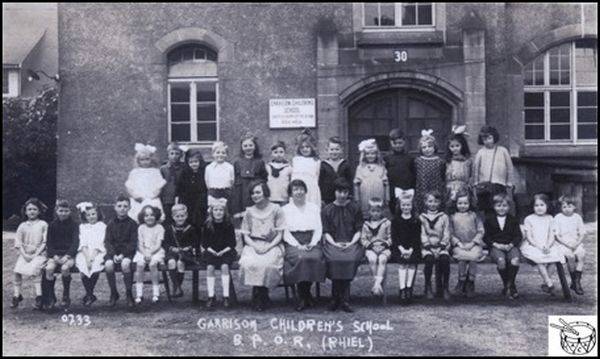
Teachers and pupils outside the Garrison Children's School in Riel taken in 1922. (Rhiel as printed on the photograph was incorrect).
At this time, British troops were part of the Rhineland Occupation Forces (under the terms of the 1918 armistice).
Image courtesy of the Army Children Archive website (link opens in a new window).